Direct Mercury Analyzers

Mercury analysis without digestion, reagents or extractable losses.

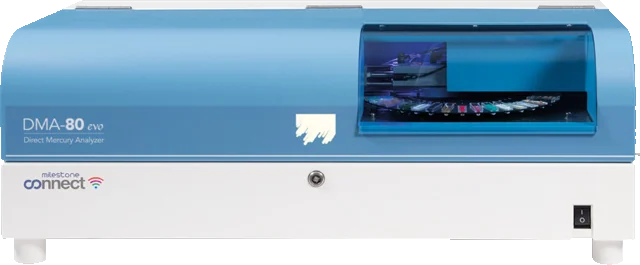
DMA-80 evo direct mercury analyzer

Analytical Instruments · 3 models

Mercury is the element most easily lost on the way to the instrument. It volatilizes during digestion, adsorbs on glassware, and carries over from one sample to the next as memory effect. Direct thermal decomposition removes those steps: the sample is weighed, heated, and the released mercury is measured. LabTech's mercury range covers direct analyzers for solid, liquid and gas matrices plus a cold-vapor system for water samples and digests.

No digestion

Solid, liquid and gas samples go in directly, so mercury is never lost in pre-treatment.

Reagent-free operation

Routine analysis consumes no chemical reagents, cutting running cost and reagent handling.

Five-minute cycle

A complete analysis takes two to five minutes, with sample weighing the only manual step.

Method-ready platform

Named in EPA 7473, HJ 923-2017 and GB 5009.17-2021 for mercury determination.

Models

Choose the configuration.

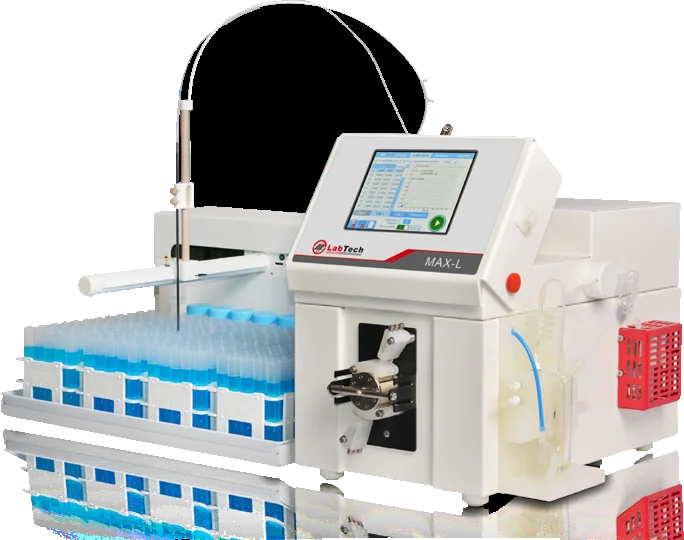
DMA-80 evo is the model the range is built around. Launched in the 1990s, it is named in EPA 7473, HJ 923-2017 and GB 5009.17-2021, and it measures down to a 0.0002 ng detection limit across a 0–30,000 ng range with RSD ≤ 1.0%. MAX-L takes the other route: tin(II) chloride reduction, gold amalgamation and a heated dual absorption cell for water and digested samples.

01

DMA-80 evo

Direct mercury analyzer, thermal decomposition with amalgamation

The direct mercury analyzer that took digestion out of mercury determination. Solid, liquid and gas samples are weighed or injected directly, decomposed thermally, and measured without reagents. The detection limit is 0.0002 ng over a 0–30,000 ng working range, with RSD ≤ 1.0%, and the instrument is named in EPA 7473, HJ 923-2017 and GB 5009.17-2021.

  • Direct injection of solid, liquid and gas matrices with no sample preparation
  • No chemical reagents consumed, which lowers running cost and handling
  • Two to five minutes per complete analysis; weighing is the only manual step
  • 0.0002 ng detection limit across a 0–30,000 ng range, seven orders of magnitude
  • RSD ≤ 1.0% repeatability, with the calibration curve checked every three to six months
  • Avoids mercury loss and cross-contamination in pre-treatment, and memory effect during analysis
  • Named in EPA 7473, HJ 923-2017 and GB 5009.17-2021
Detection limit0.0002 ng
Measuring range0–30,000 ng, seven orders of magnitude
RepeatabilityRSD ≤ 1.0%
Analysis time2–5 minutes
CalibrationStandard curve recalculated every 3–6 months
Method referencesEPA 7473, HJ 923-2017, GB 5009.17-2021
02

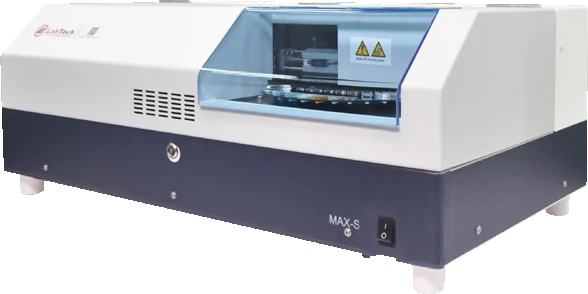
MAX-S

Direct mercury analyzer

MAX-S is listed with the DMA-80 evo as a direct mercury analyzer in the same range. The catalog presents it as the second direct-analysis model in the line and gives the detailed performance figures on the DMA-80 evo page. Configuration for a specific laboratory should be confirmed with LabTech.

  • Direct mercury analysis from a weighed sample, without acid digestion
  • Same direct-analysis approach as the DMA-80 evo, in a second model
  • Avoids the mercury losses and contamination of wet pre-treatment
  • Suited to laboratories that want mercury results without a digestion bench
03

MAX-L

Cold-vapor atomic absorption mercury analyzer

A cold-vapor atomic absorption mercury analyzer built on tin(II) chloride reduction. Mercury is reduced in solution, swept from a large-surface gas-liquid separator, concentrated on gold, and released at 950 °C into a heated dual absorption cell. It monitors water samples and digested samples, and follows the standard methods for those matrices.

  • Tin(II) chloride reduction followed by cold-vapor atomic absorption
  • Premixer and spiral mixer give thorough reagent-sample contact for complete reduction
  • Large-surface gas-liquid separator with a frosted column: fast reduction, no foaming
  • Gold amalgamation traps mercury selectively while matrix gases leave with the carrier
  • 950 °C desorption releases mercury quickly, which supports lower detection limits
  • Dual absorption cell held at up to 120 °C with a high-mercury rinse protection system
  • Six-port valve with synchronous line cleaning shortens the measurement cycle
Detection limit<0.0005 ng
Measuring range0–1,800 ng Hg
Analysis time2–5 min per sample
Cuvette2 cells, up to 120 °C
Amalgamatorup to 950 °C; 900 °C in 2 s
Autosampler40 positions, solid/liquid/gas
MethodEPA 7473; CE marked

Specifications compiled from the LabTech US product pages (labtechus.com), retrieved 31 October 2026. Prices excluded; configurations vary by region.

The range

Configurations and accessories.

Applications

Where this range is used.

  • Soils and sediments under HJ 923-2017
  • Food and foodstuffs under GB 5009.17-2021
  • Solid and solution samples by thermal decomposition under EPA 7473
  • Water samples and digested samples on the MAX-L cold-vapor system
  • Gas samples introduced directly, without trapping or digestion

Environmental & Water →

Questions

Before you buy.

Does direct mercury analysis need sample digestion?

No. On the DMA-80 evo the sample is weighed into a boat, thermally decomposed, and the mercury vapor is measured, so there is no acid digestion step. That removes the two failure modes of wet methods: mercury lost during digestion and contamination picked up from reagents and glassware. Analysis takes two to five minutes.

Which mercury analyzer should I choose, DMA-80 evo, MAX-S or MAX-L?

DMA-80 evo is the direct analyzer for solid, liquid and gas samples and carries the published performance figures, including the 0.0002 ng detection limit. MAX-L is the cold-vapor route for water samples and digested samples, using tin(II) chloride reduction and gold amalgamation. MAX-S is listed as a second direct mercury analyzer in the same range, and LabTech can confirm its configuration against your sample types.

Which standard methods does the DMA-80 evo support?

The catalog names EPA 7473, HJ 923-2017 and GB 5009.17-2021, covering solid and solution samples, soil and sediment, and food respectively. DMA-80 has been used in the development of many domestic and international standard methods since its launch in the 1990s. That history is why the instrument appears in so many regulated mercury workflows.

Send the matrix and the limit

We reply in one working day with a configuration, the consumables it needs and a lead time.