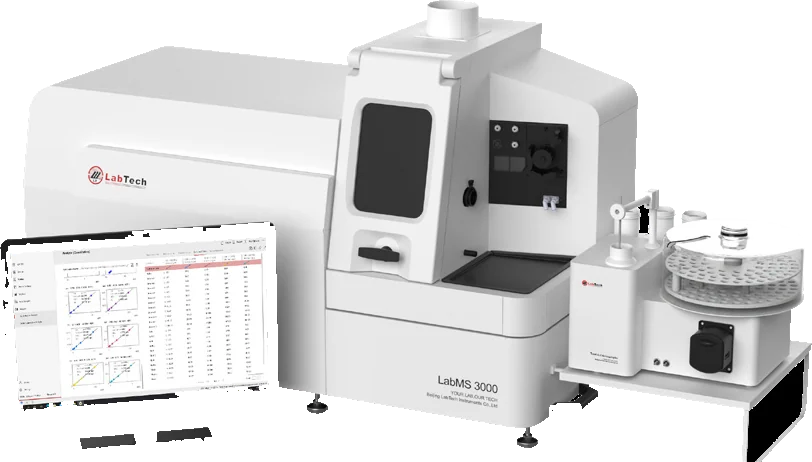
LabMS 3000 · single quadrupole ICP-MS
Trace elements
through the matrix.
A single quadrupole ICP-MS for high matrix digests, organic solvents and ultra trace work. Interference comes out in the cell, not in the sample preparation.
Send the matrix and the detection limit. We reply in one working day.
The result is decided
before the plasma.
Why it matters
The matrix decides the detection limit.
Digests carry dissolved solids. Organic methods carry carbon. Both load the plasma, and both create ions you did not ask for. The usual answer is more dilution, more preparation and a longer method.
LabMS 3000 answers at two points instead: the introduction system, where the sample meets the plasma, and the cell, where interference is removed before the detector sees it.
Dissolved solids suppress signal and drift the baseline over a long run.
Carbon builds on the interface and the plasma becomes unstable.
Interference lands on the same mass as the analyte and inflates the result.
What it does
Three points of control.
One instrument, three places where a difficult method is made routine.
Take the matrix
An integrated high matrix introduction system with online argon dilution supports high solid digests. Oxygen addition handles organic samples and keeps carbon out of the plasma.
Remove interference in the cell
A fourth generation collision reaction cell with kinetic energy discrimination removes polyatomic and doubly charged ions before they reach the detector.
Run it like a method
The HiMass workstation covers automatic tuning, method wizards and data analysis in one interface. Maintenance logs and safety protections keep long runs predictable.
How it works
One workflow, three steps.
Preparation and analysis can be specified together, from the digestion tube to the report.
Prepare
Digest in a single chamber at 300 °C and up to 200 bar with 2 to 3 mL of acid. No evaporation step is needed before analysis.
Microwave digestion range →Introduce
Load the digest directly. Online argon dilution and oxygen addition hold the plasma steady without a second dilution by hand.
ICP-MS family →Quantify
Tune, run and report from HiMass. The method you validated is the method the next operator runs.
Request a method review →Specifications
What is inside.
Published configuration data. Options, voltages and consumables are confirmed at quotation.
| Mass analyzer | Single quadrupole |
|---|---|
| Collision reaction cell | Fourth generation, kinetic energy discrimination |
| Sample introduction | Integrated high matrix system, online argon dilution |
| Organic samples | Oxygen addition |
| Software | HiMass workstation |
| Safety | Multiple protections and scheduled maintenance logs |
| Typical matrices | Water, soil, food, chemicals, wafers and alloys |
Questions
Before you ask.
What is the difference between LabMS 3000 and LabMS 5000?
LabMS 3000 is a single quadrupole ICP-MS. LabMS 5000 adds MS/MS operation and can run as a single quadrupole or a triple quadrupole. Both share the high matrix introduction system and the HiMass workstation.
Can LabMS 3000 run organic solvents?
Yes. Oxygen addition is part of the sample introduction design, which removes carbon build up in the plasma. Tell us the solvent and the flow rate and we will confirm the configuration.
How much dissolved solids can it take?
The integrated high matrix introduction system with online argon dilution is designed for high solid digests. The exact limit depends on the matrix, the analyte and the detection limit, so we confirm it against your method before quotation.
Does it connect to LabTech sample preparation?
Yes. LabMS 3000 connects to the LabTech digestion and automation ranges, so preparation and analysis can be specified as one workflow.
What software does it use?
The HiMass workstation covers automatic tuning, method wizards and data analysis in one interface, with scheduled maintenance logs.
Is it certified for semiconductor laboratories?
SEMI S2 certification is published for LabMS 5000, not for LabMS 3000. If you work to a semiconductor safety or cleanroom specification, send it to us and we will confirm the correct model.
What do you need to quote?
The matrix, the analytes, the detection limit you have to reach, the sample volume per day and the supply voltage in your laboratory.
How fast is a quotation?
One working day. Send the method details and we reply with a configuration, the consumables it needs and a lead time.
Next step
Send the matrix and the limit.
We reply in one working day with a configuration, the consumables it needs and a lead time. No account, no form gate.
Prefer email? sales@bgmro.com
WhatsApp +86 188 5311 2213