ICP-MS Systems

Single-quadrupole and triple-quadrupole trace-element analysis.

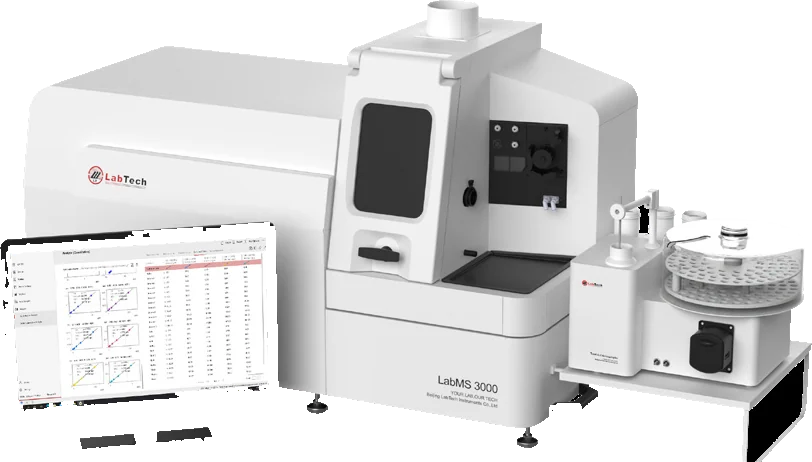
LabMS 3000 ICP-MS

Analytical Instruments · 2 models

Trace-element work stalls when the matrix is heavier than the calibration standards. LabTech's ICP-MS range addresses that at the front end: an integrated high-matrix introduction system with online argon dilution supports high-solid digests, and oxygen addition handles organic samples, so less preparation happens before the plasma. Both models share a stable ion source, a high-sensitivity detector with a wide dynamic range, and the HiMass workstation, which covers automatic tuning, method wizards and data analysis in one interface.

High-matrix inlet

Online argon dilution and oxygen addition for organic samples cut preparation steps and contamination risk.

Interference control

The fourth-generation collision/reaction cell removes polyatomic and doubly charged ions for lower detection limits.

MS/MS when needed

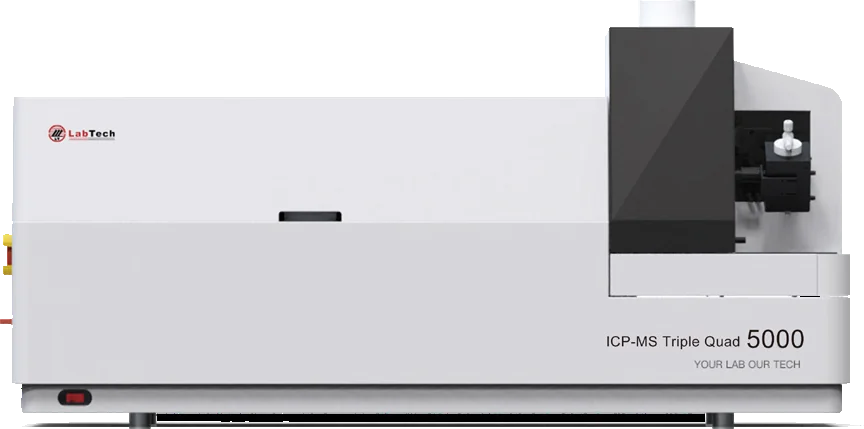
LabMS 5000 runs single-quadrupole or triple-quadrupole mode, matching the instrument to each method.

SEMI S2 safety

Up to ten safety protections and scheduled maintenance logging keep long unattended runs predictable.

Models

Choose the configuration.

Two models cover different interference problems. LabMS 3000 uses a fourth-generation collision/reaction cell with kinetic energy discrimination to remove polyatomic and doubly charged ions. LabMS 5000 adds MS/MS operation for controlled, reliable interference removal and can run as a single quadrupole or a triple quadrupole, so one instrument serves routine suites and ultra-trace work. Both connect to LabTech's sample-preparation systems, which lets a laboratory specify digestion and analysis as one workflow.

01

LabMS 3000

Inductively coupled plasma mass spectrometer (ICP-MS)

A single-quadrupole ICP-MS for routine and high-matrix trace-element analysis. The integrated high-matrix introduction system takes digests with a heavy dissolved-solids load and organic solvents, while the fourth-generation collision/reaction cell handles polyatomic and doubly charged interferences. It is aimed at laboratories that need low detection limits on a single-quadrupole platform and a short path from sample to report.

  • Integrated high-matrix introduction system with online argon dilution
  • Oxygen addition for organic samples, removing carbon build-up in the plasma
  • Fourth-generation collision/reaction cell with kinetic energy discrimination
  • Removes polyatomic and doubly charged interferences for lower detection limits
  • HiMass workstation with one-click operation, method wizards and modular tools
  • Scheduled maintenance logs and multiple safety protections reduce unplanned downtime
  • Connects to LabTech sample-preparation systems for one element-analysis workflow
Mass analyzerSingle quadrupole
Collision/reaction cellFourth generation, kinetic energy discrimination
Sample introductionIntegrated high-matrix system, online argon dilution
SoftwareHiMass workstation
02

LabMS 5000

Triple-quadrupole ICP-MS (ICP-MS/MS)

A triple-quadrupole ICP-MS that switches between single-quadrupole and MS/MS operation, so routine suites and difficult interferences share one instrument. In MS/MS mode, interference removal is controlled and predictable, which is what ultra-trace work depends on. A 27 MHz solid-state generator and a full-matrix introduction system hold the signal steady when high-matrix samples are injected directly.

  • MS/MS mode for controlled, reliable removal of mass interference ions
  • Single-quadrupole and triple-quadrupole capability selected per application
  • 27 MHz industrial-standard solid-state generator for system stability
  • Full-matrix introduction system and reinforced ion transfer reduce signal drift
  • SEMI S2 certified, with up to ten safety protections
  • HiMass workstation with one-click, wizard-driven operation
Mass analyzerTriple quadrupole, switchable to single-quadrupole mode
Generator27 MHz solid-state
SafetySEMI S2 certified, up to ten safety protections
Sample introductionFull-matrix introduction system
SoftwareHiMass workstation

Full specifications for other configurations, voltages and options are available on request.

The range

Configurations and accessories.

Applications

Where this range is used.

  • Trace metals in high-matrix digests and directly injected samples
  • Organic solvent samples analyzed with oxygen addition to remove carbon
  • Trace elements in food and agricultural products
  • Trace contamination in semiconductor materials
  • High-purity metals and alloy certification
  • Geological and nuclear-industry samples

Environmental & Water → · Pharmaceutical & Biopharma → · Semiconductor & High-Purity Materials →

Questions

Before you buy.

What is the difference between the LabMS 3000 and the LabMS 5000?

LabMS 3000 is a single-quadrupole ICP-MS built on a fourth-generation collision/reaction cell with kinetic energy discrimination. LabMS 5000 adds MS/MS operation for controlled interference removal and can be run in single-quadrupole or triple-quadrupole mode. Both share the HiMass workstation and the high-matrix sample introduction approach.

How does the collision/reaction cell remove interferences?

The cell applies kinetic energy discrimination to suppress polyatomic and doubly charged ions before they reach the analyzer, which lowers background at the masses of interest. On LabMS 5000, MS/MS mode adds a second stage of mass selection so interfering ions can be removed in a controlled way. The practical result is lower detection limits on difficult matrices.

Does the LabMS 5000 suit semiconductor laboratories?

The instrument is SEMI S2 certified and carries up to ten safety protections, the certification semiconductor facilities look for before installation. MS/MS interference removal is aimed at ultra-trace work in high-matrix samples, and the full-matrix introduction system reduces signal drift when those samples go in directly.

Send the matrix and the limit

We reply in one working day with a configuration, the consumables it needs and a lead time.