Manual SPE and Sample Cleanup Accessories

Manifolds, membrane drying, nitrogen evaporation and waste alarms for sample cleanup.

ET nitrogen evaporator

Organic Sample Preparation · 5 models

Not every laboratory needs a robotic platform, and manual preparation remains the practical choice for low batch counts, method development and work where consumable cost dominates. LabTech's accessory line covers that ground: a manifold and a column-and-disk system for solid-phase extraction, a membrane dryer that replaces anhydrous sodium sulfate, a nitrogen concentrator for parallel evaporation, and an alarm that watches the waste container.

PEEK for PFAS work

Extrapid's internal contact parts are all PEEK, holding background low enough for per- and polyfluoroalkyl substance analysis.

Dries without sodium sulfate

IFAD draws sample through a PTFE membrane under vacuum, so no drying agent enters the extract.

12 or 24 positions

W-SPE takes standard-size extraction cartridges on a manifold with an independent valve at every position.

Waste-level alarm

RWAI senses the liquid level in the waste container and alarms before an overflow reaches the floor.

Models

Choose the configuration.

Each step in the sequence has its own failure mode. Water carried into a GC inlet produces a swollen, distorted peak; sodium sulfate added by hand introduces a variable blank; a full waste container quietly floods the floor. These accessories address those points directly, and because they sit before the instrument rather than inside it, they can be added to an existing workflow without changing the separation method.

01

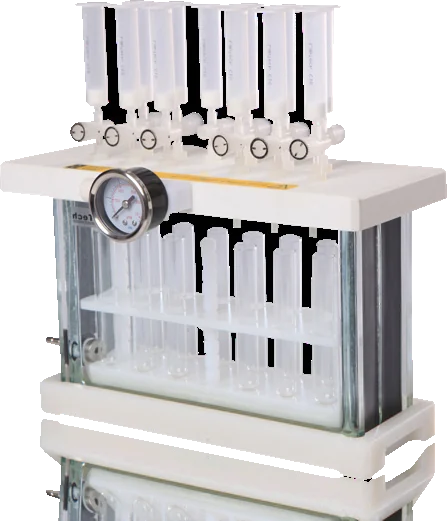
W-SPE

Manual solid-phase extraction manifold

W-SPE is a manual manifold for the extraction and enrichment of organic compounds. It accepts standard-size solid-phase extraction cartridges and gives each position its own valve, so flow through individual cartridges can be controlled during conditioning, loading and elution. It is available in 12- or 24-position versions and is intended for routine, low-volume cleanup work.

  • Manual manifold for organic extraction and enrichment
  • Accepts standard-size solid-phase extraction cartridges
  • Independent valve at each position, imported from the United States
  • 12- or 24-position configuration to match batch size
  • Simple operation and durable construction for daily use
Positions12 or 24
Cartridge formatStandard-size SPE cartridges
02

IFAD

PTFE-membrane drying and water-removal device

IFAD removes water from an organic extract without adding a drying agent. Under vacuum, the sample is drawn across a PTFE membrane; the hydrophobic membrane passes organic solvent while the aqueous phase is retained in the filter cup. It replaces anhydrous sodium sulfate in the drying step, which removes the drying-agent weighing step from the workflow.

  • PTFE membrane exploits hydrophobicity to separate solvent from water
  • Vacuum draws the sample across the separation membrane
  • Organic solvent passes through; the aqueous phase stays in the filter cup
  • Replaces anhydrous sodium sulfate as the drying step
  • Keeps drying agent out of the extract and out of the analysis
Membrane materialPTFE
03

ET

Nitrogen blowdown concentrator

ET is a nitrogen blowdown concentrator for parallel sample concentration. Nitrogen flow is combined with heating, and the metal bath avoids the condensation problems that a water bath creates, so several extracts can be brought down in one batch. It is a straightforward bench instrument for the solvent-reduction step that follows extraction and precedes injection.

  • Nitrogen blowdown combined with heating for rapid concentration
  • Metal bath heating avoids water-vapor condensation
  • Parallel concentration of several samples in one batch
  • Quick, simple operation for routine solvent reduction
  • Concentrates extracts ahead of GC and LC analysis
HeatingMetal bath
04

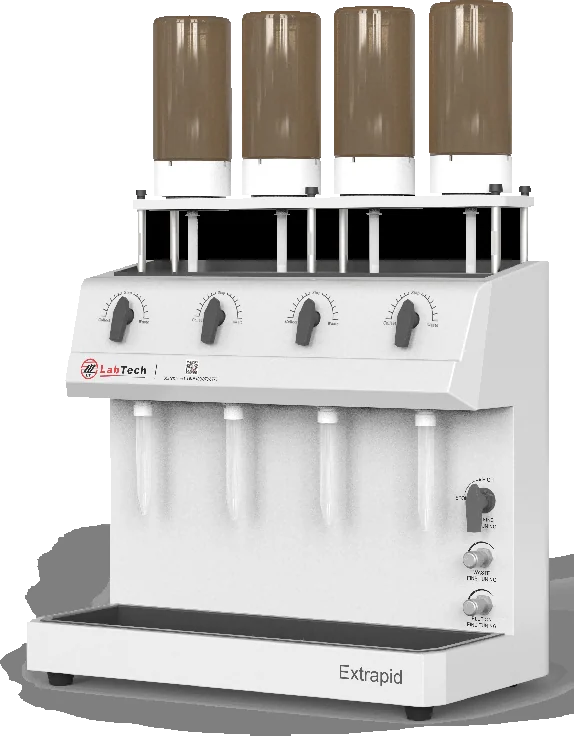
Extrapid

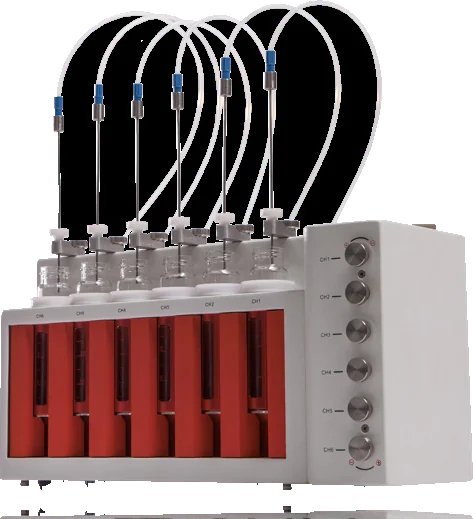
Manual column-and-disk solid-phase extraction system

Extrapid combines cartridge and disk solid-phase extraction on a single manual instrument. It covers small-volume work with 1, 3 and 6 mL cartridges and larger volumes with 47 mm and 90 mm extraction disks, and each channel has a fine-adjust valve for flow control. The internal contact materials are all PEEK, which keeps the system suitable for trace-level and PFAS analysis while remaining an economical alternative.

  • Column and disk extraction on one instrument
  • Takes 1, 3 and 6 mL cartridges plus 47 mm and 90 mm disks
  • Per-channel flow fine-adjust valves for controlled, reproducible extraction
  • All-PEEK internal contact materials for ultra-low background
  • Economic choice that covers small and large sample volumes
Cartridges1, 3 and 6 mL
Disks47 mm and 90 mm
Wetted materialsPEEK
05

RWAI

Waste-liquid level alarm

RWAI monitors the liquid level in a waste container and sounds an alarm when it passes the set limit. It is fitted to chromatographs and sample preparation instruments that discharge organic waste, where the container is often out of sight below the bench. The alarm turns an unmonitored overflow into a prompt to empty the vessel.

  • Sensor detects the waste-liquid level in the container
  • Alarms automatically once the level passes the limit
  • Suits chromatographs and preparation instruments that discharge organic waste
  • Addresses containers that are difficult to inspect during a run

Full specifications for other configurations, voltages and options are available on request.

The range

Configurations and accessories.

Applications

Where this range is used.

  • Cleanup of pesticide residues in food and agricultural extracts
  • PFAS extraction where low background is essential
  • Water and wastewater extraction and enrichment
  • Solvent reduction of extracts before GC-MS
  • Drying organic extracts ahead of injection
  • Waste monitoring on chromatography benches

Questions

Before you buy.

What is the difference between W-SPE and Extrapid?

W-SPE is a manual manifold that runs standard-size solid-phase extraction cartridges, with 12 or 24 positions and an independent valve at each. Extrapid adds disk extraction: it accepts 1, 3 and 6 mL cartridges and 47 mm and 90 mm disks on one instrument, with per-channel flow valves and all-PEEK contact materials for low background.

Can IFAD replace anhydrous sodium sulfate in my extraction?

IFAD is designed for that step. Under vacuum the extract passes a PTFE membrane that lets organic solvent through and retains the aqueous phase in the filter cup. Because no drying agent is added, the blank contribution from sodium sulfate is removed from the method.

How does the RWAI waste alarm work?

A sensor tracks the waste-liquid level and triggers an alarm when it exceeds the limit, so the container can be emptied before it overflows. It is intended for chromatographs and preparation instruments that discharge organic waste, where the container sits out of sight.

Send the matrix and the limit

We reply in one working day with a configuration, the consumables it needs and a lead time.