Parallel Concentration and Evaporation

Water-bath heating and nitrogen blow-down across 64 positions at once.

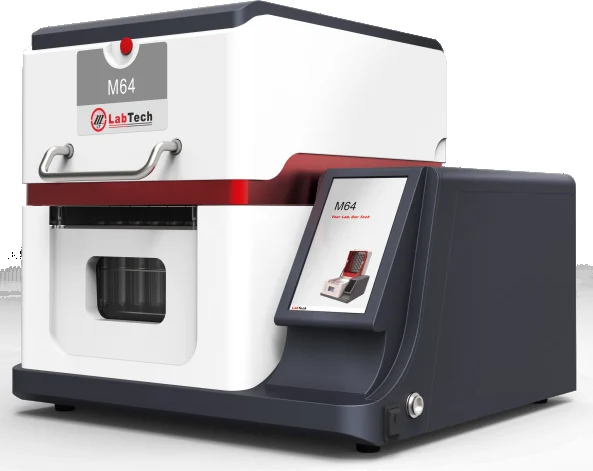
M64 automated high-throughput parallel concentrator

Organic Sample Preparation · 3 models

Concentrating a batch of extracts is the step that quietly consumes a working day: solvent has to be removed to a defined volume without losing volatile analytes, and someone has to watch each vessel. LabTech's parallel concentration systems replace that manual watch with water-bath heating and controlled nitrogen blow-down across many positions at once. M64 and M32 handle 64 and 32 positions, while MultiVap-10 provides ten channels with automatic endpoint detection for work that must reach an exact final volume.

Nitrogen used where needed

Needles descend with the liquid level, so nitrogen reaches the surface instead of the headspace and gas consumption falls.

Unattended with completion signal

The run continues without an operator and signals when concentration finishes, freeing the fume hood and the analyst.

Visible without opening

An illuminated front window shows concentration progress, so the lid stays closed and the run stays undisturbed.

Lid interlock

The lid locks during concentration, stops the run when opened and resumes automatically once it is closed again.

Models

Choose the configuration.

The design decisions are about gas and time. Blow-down needles follow the liquid level down, so nitrogen is not wasted on an empty headspace, and pressure is regulated by program rather than by how many channels happen to be open. An illuminated front window lets an operator see the vessels without lifting the lid, and the lid locks during concentration and stops the run if opened. MultiVap-10 adds automatic endpoint detection for to-volume work.

01

M64

64-position automated high-throughput parallel concentrator

M64 is the 64-position model in the automated high-throughput parallel concentrator line. It uses water-bath heating and nitrogen blow-down to concentrate up to 64 samples at once and accepts several vial specifications in the same batch. It is intended for laboratories where sample numbers, rather than method complexity, set the daily pace, and it runs unattended with an end-of-concentration signal.

  • Concentrates up to 64 samples simultaneously in one batch.
  • Water-bath heating with nitrogen blow-down shortens evaporation time.
  • Blow-down needles descend with the liquid level to reduce gas use.
  • Nitrogen pressure is program-controlled and unaffected by the open channel count.
  • Lid locks during concentration; opening it stops the run and closing resumes it.
  • Illuminated front window keeps the process visible without opening the lid.
  • Accepts several sample vial specifications in the same run.
Positions64
HeatingWater bath
GasNitrogen blow-down with level-following needles
LidAutomatic lock, run stops when opened and resumes when closed
02

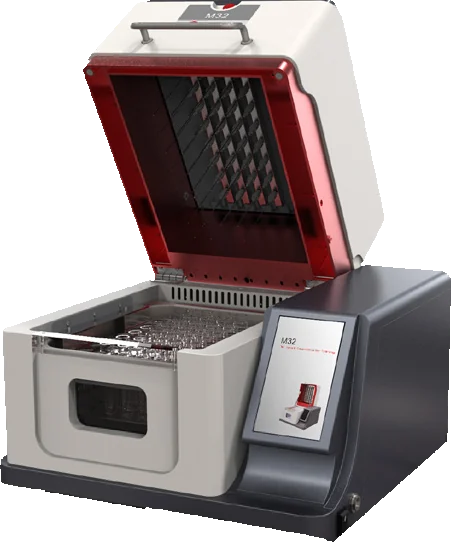
M32

32-position automated high-throughput parallel concentrator

M32 is the 32-position version of the same automated parallel concentrator. It concentrates 32 samples at once under water-bath heating and nitrogen blow-down, uses the same level-following needles and program-controlled pressure, and gives laboratories a batch size that matches smaller daily workloads. Like M64, it runs unattended and signals when concentration finishes.

  • Concentrates up to 32 samples simultaneously in one batch.
  • Water-bath heating with nitrogen blow-down shortens evaporation time.
  • Blow-down needles descend with the liquid level to reduce gas use.
  • Nitrogen pressure is program-controlled and unaffected by the open channel count.
  • Lid locks during concentration; opening it stops the run and closing resumes it.
  • Illuminated front window keeps the process visible without opening the lid.
  • Accepts several sample vial specifications in the same run.
Positions32
HeatingWater bath
GasNitrogen blow-down with level-following needles
03

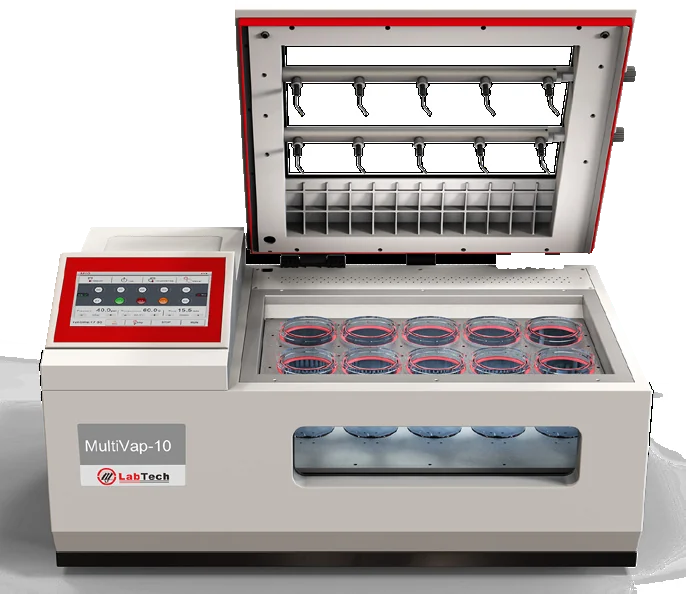
MultiVap-10

Ten-channel quantitative parallel concentrator

MultiVap-10 is a ten-channel quantitative concentrator. Its channels run together or individually, and it accepts 200 mL and 50 mL concentration cups in the same batch, with vortex nitrogen blow-down whose position and angle can be set for the cup and the sample volume. It detects the concentration endpoint and stops at volume automatically, without an operator watching the vessel.

  • Ten sample channels operate together or independently.
  • Accepts 200 mL and 50 mL cups, and both sizes can run at the same time.
  • Vortex nitrogen blow-down with adjustable position and angle per cup.
  • Automatic endpoint detection delivers fully automatic to-volume concentration.
  • Enclosed design allows operation outside a fume hood.
  • Front window shows the vessels without removing them for inspection.
  • Unattended operation with an automatic end-of-concentration prompt.
Channels10, simultaneous or independent
Cups200 mL and 50 mL, usable together
EndpointAutomatic detection with to-volume concentration
GasVortex nitrogen blow-down, adjustable position and angle

Full specifications for other configurations, voltages and options are available on request.

The range

Configurations and accessories.

Applications

Where this range is used.

  • Pesticide residue extracts in acetonitrile or ethyl acetate before GC-MS
  • PAH and PCB extracts from soil and sediment
  • Food and feed extracts requiring volume reduction before cleanup
  • Water extracts concentrated after solid-phase extraction
  • Batches of 50 mL centrifuge tube extracts in high-throughput workflows

Food & Agriculture →

Questions

Before you buy.

What is the difference between M64, M32 and MultiVap-10?

M64 and M32 are the same automated high-throughput design in 64-position and 32-position versions, using water-bath heating and nitrogen blow-down. MultiVap-10 has ten channels that run together or separately, accepts 200 mL and 50 mL cups, and detects the concentration endpoint for automatic to-volume operation.

Can parallel concentration replace a rotary evaporator?

For batch work, yes. The concentrators use water-bath heating and nitrogen blow-down, run unattended with an end-of-concentration prompt, and free the fume hood for other work. Rotary evaporation remains useful for a single large volume, while the parallel systems are aimed at many small and medium vessels at once.

How is nitrogen consumption controlled?

Blow-down needles descend with the liquid level, so gas is delivered close to the surface rather than into an empty headspace. Nitrogen pressure is program-controlled and does not change when channels are switched on or off, and the instrument adjusts gas flow through the concentration run.

Send the matrix and the limit

We reply in one working day with a configuration, the consumables it needs and a lead time.