Automated Iodine Analyzer

Urine and water iodine by arsenic-cerium catalytic spectrophotometry, sample to report.

I-Lab1100 automated iodine analyzer

Laboratory Equipment · 1 model

Iodine status studies live or die on throughput and reproducibility. I-Lab1100 runs the whole arsenic-cerium catalytic spectrophotometric method automatically: reagent addition, digestion, cooling, catalysis, curve fitting, measurement and the analytical report. The assay follows national standards and Ministry of Health industry standards, so the method a laboratory validates is the method the instrument runs. The operator loads tubes and the analyzer handles the sequence.

The full method, automated

Reagent addition, digestion, cooling, catalysis, curve fitting and reporting run without operator steps.

180 positions

A 180-position tray and 10 reagent channels keep a study batch moving through the day.

No transfer after digestion

An integrated 8–35 °C thermostat cools samples in place, removing a manual transfer step.

Built to standards

The method follows national and Ministry of Health industry standards for urine and water iodine.

Models

Choose the configuration.

The hardware is built for the two matrices that matter. Urine iodine reads from 2 to 1200 µg/L and water iodine from 1 to 600 µg/L, with RSD ≤3% at low concentration and ≤2% at high concentration, and linearity of R² ≥0.999. An integrated 8–35 °C cooling thermostat shares the chassis with a 180-position sample tray, so digested samples enter constant temperature without being transferred.

01

I-Lab1100

Automated iodine analyzer using arsenic-cerium catalytic spectrophotometry

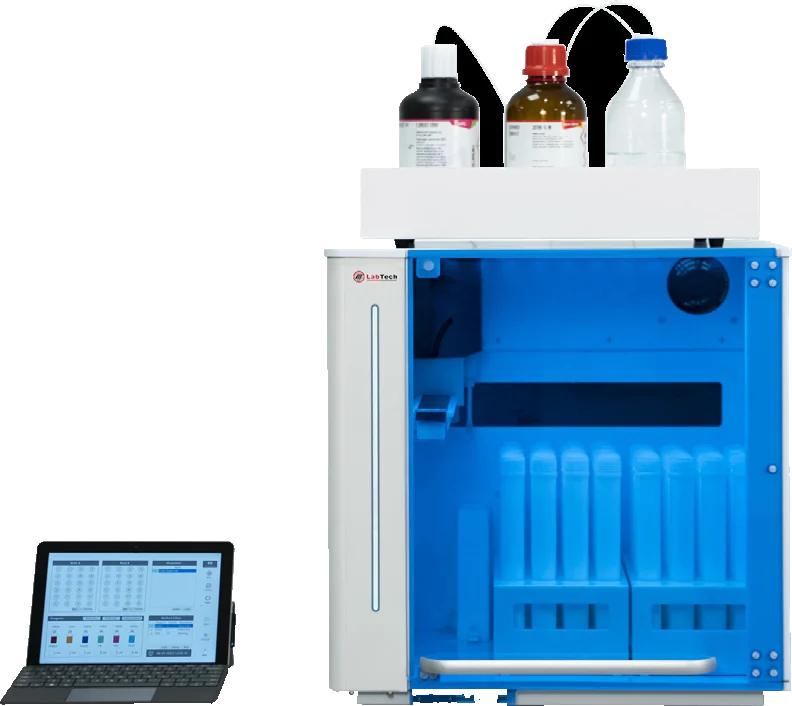
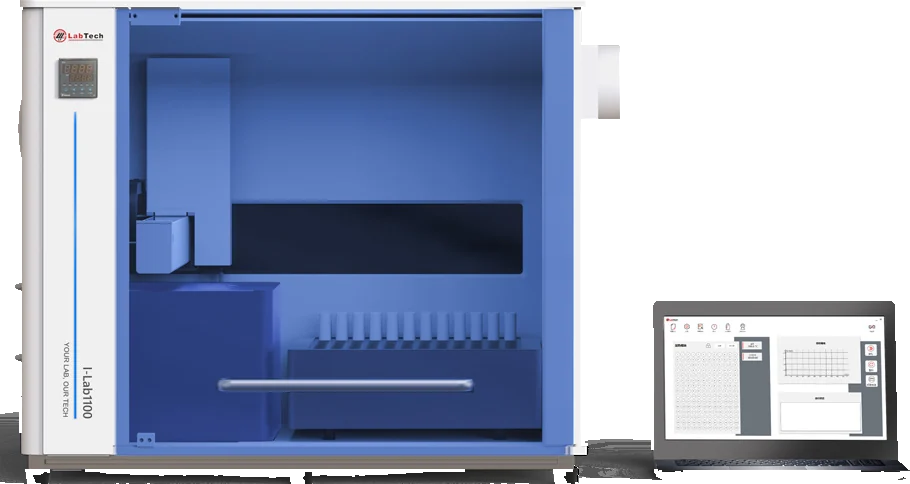
A walk-away analyzer for urine and water iodine. The 180-position tray, 10-channel reagent delivery and XYZ arm cover the full arsenic-cerium catalytic method, from digestion at up to 120 °C through curve fitting to report output. Dual-pump washing cleans the lines and discharges waste automatically between batches.

  • 180 sample positions per run
  • 10 reagent channels delivered by an XYZ three-axis robotic arm
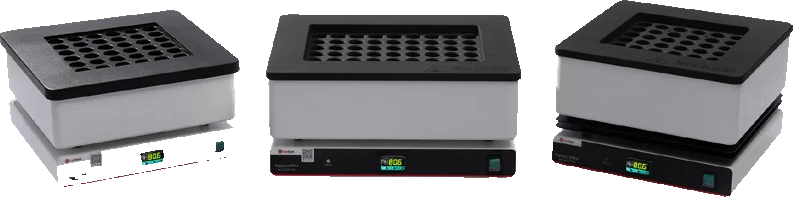
  • Digestion from room temperature to 120 °C with ±0.1 °C control accuracy
  • Integrated 8–35 °C cooling thermostat; no sample transfer after digestion
  • Integrated UV detector with selectable 380, 400 and 420 nm wavelengths, ±2 nm accuracy
  • RSD ≤3% at low concentration and ≤2% at high concentration; R² ≥0.999
  • Dual-pump washing with automatic cleaning and waste discharge
Sample positions180
Reagent channels10, positioned by an XYZ three-axis robotic arm
Digestion rangeRoom temperature to 120 °C
Temperature control accuracy±0.1 °C
Constant temperature mode8–35 °C, integrated cooling thermostat
Detection wavelengths380, 400, 420 nm; accuracy ±2 nm
Measuring rangeUrine iodine 2–1200 µg/L; water iodine 1–600 µg/L
PrecisionRSD ≤3% (low concentration), ≤2% (high concentration)
LinearityR² ≥0.999
WashingDual-pump structure, automatic cleaning and waste discharge

Full specifications for other configurations, voltages and options are available on request.

Applications

Where this range is used.

  • Urine iodine in population iodine status surveys
  • Water iodine in drinking water and source water
  • Batch iodine screening in public health laboratories
  • Iodine deficiency monitoring programs
  • Linear calibration checks requiring R² ≥0.999

Clinical & Medical →

Questions

Before you buy.

What method does the I-Lab1100 use to measure iodine?

It uses arsenic-cerium catalytic spectrophotometry, in line with national standards and Ministry of Health industry standards, for both urine iodine and water iodine. The analyzer performs the complete workflow itself: reagent addition, digestion, cooling, catalysis, curve fitting, detection and the analytical report, which removes the manual steps where operator error usually enters.

What concentration range and precision does the analyzer deliver?

Urine iodine is measured from 2 to 1200 µg/L and water iodine from 1 to 600 µg/L. Relative standard deviation is ≤3% at low concentration and ≤2% at high concentration, with a linear correlation coefficient of R² ≥0.999. Wavelength accuracy is ±2 nm across the 380, 400 and 420 nm channels.

How much operator time does a batch take?

The tray holds 180 sample positions, so a large study batch loads once and runs. Reagent delivery uses 10 channels, and the integrated 8–35 °C thermostat cools samples in place after digestion, so nothing has to be moved by hand. Dual-pump washing cleans the system and discharges waste automatically before the next batch.

Send the matrix and the limit

We reply in one working day with a configuration, the consumables it needs and a lead time.