Automated Sample Processing and Biobanking

Weighing, aliquoting, capping, filtration and membrane biobanking on one modular line.

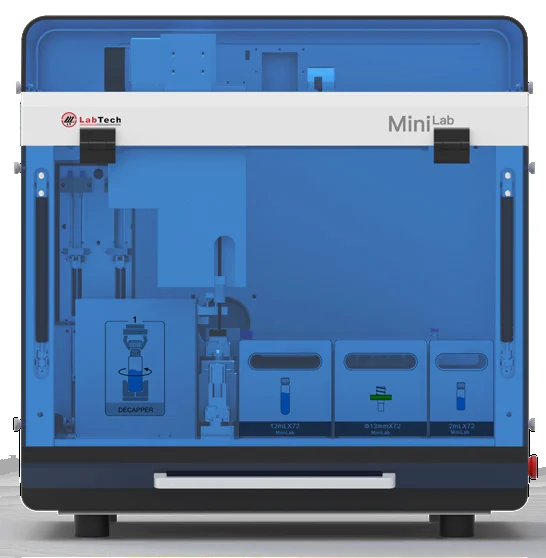
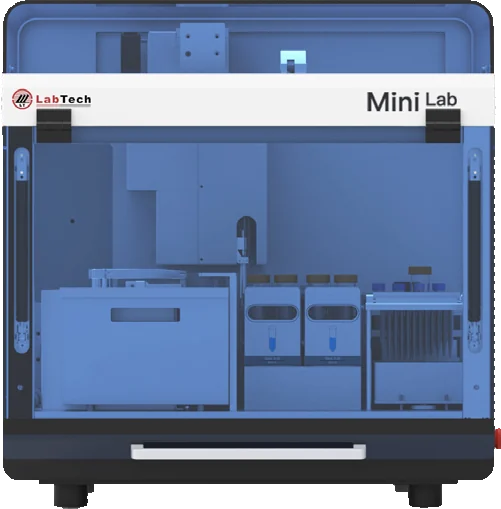
MiniLab5000-G automated sample aliquoting and weighing system

Automation & Robotics · 5 models

Between the sample bag and the autosampler sits a sequence that is still manual in many laboratories: weigh, record, aliquot, cap, filter, store. Every handover is a chance to lose the link between a result and the sample it came from. The MiniLab5000 processing modules each take one part of that sequence, from weighing and aliquoting through capping, filtration, membrane concentration, membrane punching and enzyme digestion, and run it under software.

0.00001 g balance

A Mettler-Toledo balance reads to 0.0001 or 0.00001 g, so aliquots are recorded by weight rather than by eye.

Over 400 a day

The filtration module runs more than 400 samples per day, with racks for 2, 15 or 50 mL tubes.

3 minutes per sample

Empore filters and dries a urine sample in about three minutes, and the membrane stores for 10 years.

Clog-aware filtration

A pressure sensor detects a blocked filter, slows the stroke and re-pushes to keep resistant samples moving.

Models

Choose the configuration.

The biobanking modules are the least conventional. MiniLab5000-Empore concentrates urine protein on a membrane by vacuum filtration and heated drying, then stores the dried membrane instead of the 8 to 10 mL of raw urine that freezer storage requires. Throughput is about three minutes per sample, with a stated storage life of 10 years. MiniLab5000-Disk punches 25 or 47 mm membrane discs into a 96-well plate, so a stored sample can be eluted straight into the assay.

01

MiniLab5000-G

Automated aliquoting and weighing system

MiniLab5000-G weighs and dispenses solid powder and liquid samples, then carries them through dissolution, dilution to volume and vortex mixing. A Mettler-Toledo balance reads to 0.0001 or 0.00001 g, and powder dispensing is controlled by high-frequency vibration with a tilt-angle dynamic PID algorithm. Vials are capped automatically between steps, which matters for hygroscopic powders.

  • Standard weighing, powder and liquid aliquoting, dissolution and dilution to volume in one workflow
  • Mettler-Toledo balance reading to 0.0001 or 0.00001 g for automatic weighing
  • High-frequency vibration and tilt-angle PID control for powder dispensing
  • Liquid handling from 0 to 200,000 cps, with tips made for viscous samples
  • Dual-station capping keeps open vials from taking up moisture or losing volatiles
  • Optional dehumidification module, or a sealed chamber under nitrogen protection
  • PP working chamber built to cleanroom practice for corrosion resistance and cleanliness
Balance readability0.0001 g or 0.00001 g
Viscosity range0 to 200,000 cps
02

MiniLab5000-F

Automated capping, pipetting and filtration system

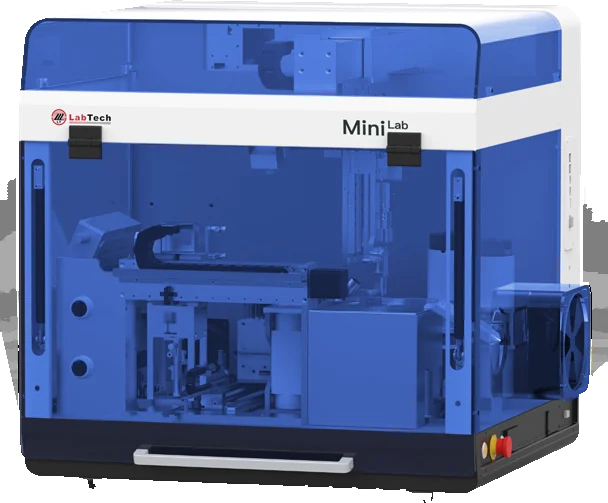
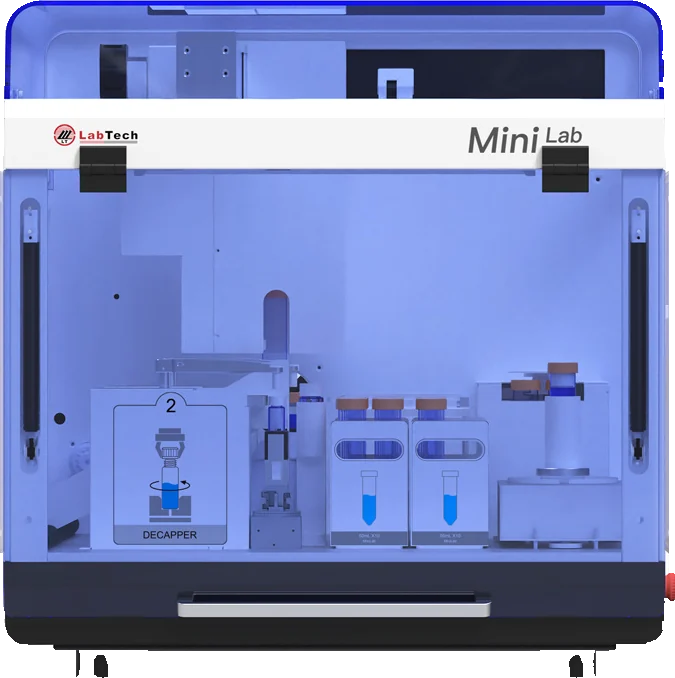
MiniLab5000-F caps and uncaps tubes, pipettes and filters at high throughput, handling more than 400 samples a day on racks for 2 mL, 15 mL or 50 mL tubes. Pipetting uses a bullet-piston syringe with overpressure protection, and a pressure sensor notices a blocking filter and raises the filtration force rather than stalling. Two capping stations sense how tight each cap is and normalize it before the run.

  • More than 400 samples processed per day
  • Racks for 72 by 2 mL, 72 by 15 mL or 21 by 50 mL tubes
  • Bullet-piston injection with automatic overpressure protection and re-push
  • Pipetting error and repeatability better than the JJG 646-2006 verification requirement
  • Pressure sensor detects a blocked filter and raises filtration force automatically
  • Dual-station capping senses cap tightness and corrects loose or over-tight caps
ThroughputMore than 400 samples per day
Sample racks72 by 2 mL, 72 by 15 mL, 21 by 50 mL
03

MiniLab5000-Empore

Membrane filtration and drying system for biological samples

MiniLab5000-Empore concentrates and stores urine protein on a membrane instead of in a freezer. Vacuum filtration and heated drying run automatically, and the dried membrane holds the protein concentrate for later elution. LabTech quotes about three minutes per sample and a 10-year storage life, against the 8 to 10 mL of raw urine that conventional freezer or liquid nitrogen storage requires.

  • Vacuum filtration and heated drying in one automated flow
  • Membrane enrichment replaces bulk urine storage
  • About 3 minutes per sample
  • Stated storage life of 10 years for the dried membrane
  • Avoids the repeated freeze-thaw cycles that degrade protein
  • Less manual handling and a lower risk of cross-contamination
Processing time3 minutes per sample
Storage life10 years
04

MiniLab5000-Disk

Automated membrane punch

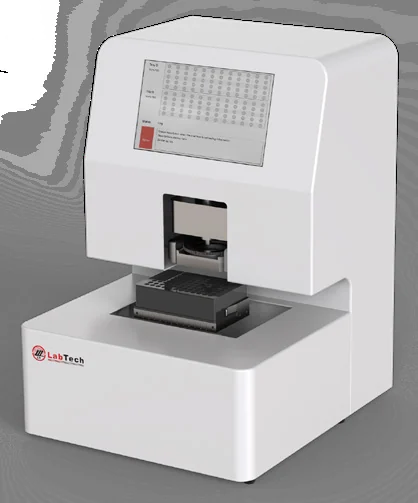
MiniLab5000-Disk cuts discs from 25 or 47 mm membrane samples and deposits them in a 96-well collection plate. The plate can go directly to elution or further processing, which removes a manual punching step and the handling that comes with it. Barcode entry ties each disc back to the membrane it came from.

  • Automatic punching of 25 mm and 47 mm membranes
  • Discs collected into a 96-well plate for direct elution
  • Barcode entry and data traceability for each membrane
  • Less manual handling, so less cross-contamination risk
  • Feeds downstream elution without a transfer step
Membrane size25 mm or 47 mm
Collection format96-well plate
05

MiniLab5000-Enzyme

Enzyme digestion system for biological samples

MiniLab5000-Enzyme prepares urine, protein and small-molecule drug samples by automating the digestion sequence. Plate transfer, washing, tip-based reagent addition, tip pipetting, enclosed constant-temperature incubation in the dark, and filtration all run on the system. The function modules can be combined to match a given assay rather than fixed to one protocol.

  • 8-channel pipetting for plate-based workflows
  • Enclosed constant-temperature heating for controlled digestion
  • Dark incubation for light-sensitive reactions
  • Orbital and linear shaking modes
  • Combined modules cover plate transfer, washing, addition, pipetting and filtration
Pipetting channels8

Full specifications for other configurations, voltages and options are available on request.

The range

Configurations and accessories.

Applications

Where this range is used.

  • Urine protein enrichment and long-term membrane storage
  • Weighing and aliquoting powder and liquid samples for batch quality control
  • Capping, pipetting and filtering sample tubes at high throughput
  • Punching 25 or 47 mm membrane discs into 96-well plates for elution
  • Enzymatic digestion of urine and protein samples before LC-MS
  • Tube capping and decapping ahead of automated analysis

Clinical & Medical →

Questions

Before you buy.

How does MiniLab5000-Empore store urine protein samples?

It concentrates the protein on a membrane by vacuum filtration, dries the membrane with heat, and stores the dried membrane instead of the raw urine. The quoted figures are about three minutes per sample and a 10-year storage life, and the format avoids the repeated freeze-thaw cycles that cause protein degradation.

How many samples can MiniLab5000-F process in a day?

More than 400 samples per day. It accepts racks of 72 by 2 mL, 72 by 15 mL or 21 by 50 mL tubes, caps and uncaps each tube, and monitors filter pressure so that a blocked filter is handled rather than aborting the batch.

Which containers do the sample processing modules accept?

The line covers 2 mL vials, blood collection tubes, headspace vials, centrifuge tubes, and racks of 2 mL, 15 mL and 50 mL tubes, depending on the module. MiniLab5000-Disk instead works with 25 or 47 mm membranes and collects punched discs in a 96-well plate.

Send the matrix and the limit

We reply in one working day with a configuration, the consumables it needs and a lead time.